The Hidden Cost of Legacy Systems: When “It Still Works” Isn’t Good Enough

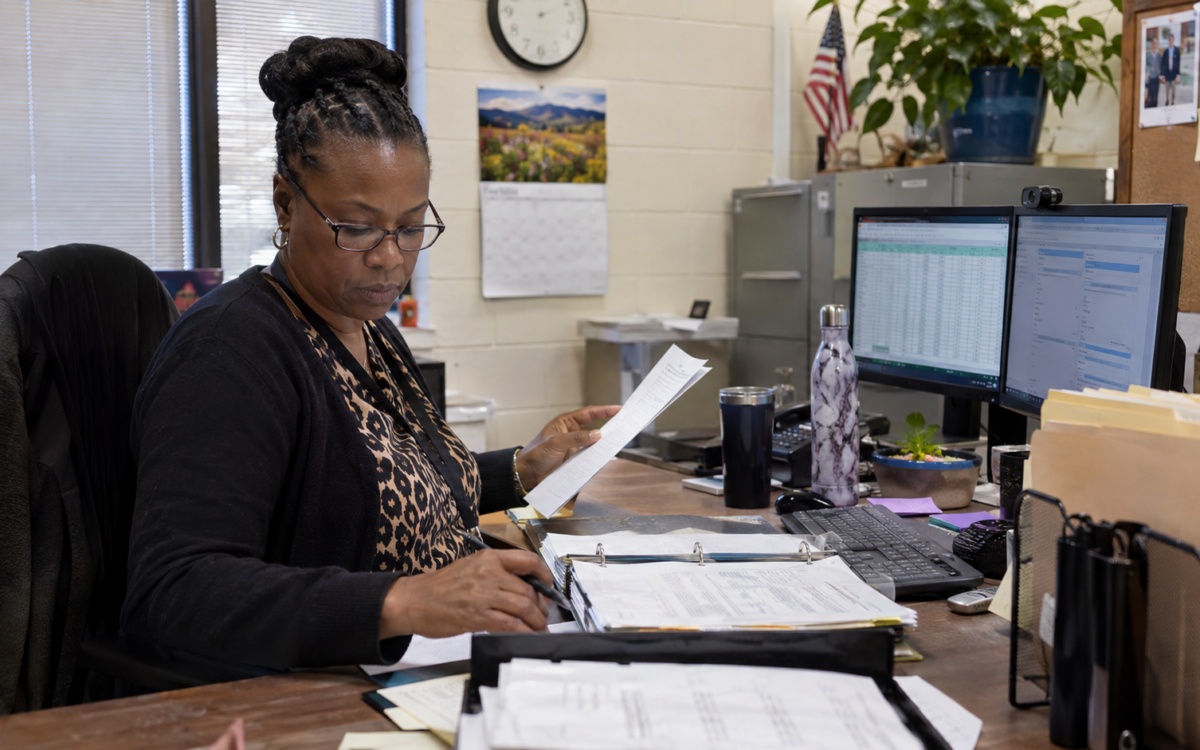
Government employee cross-referencing printed records in a binder against a spreadsheet and an application on two monitors, showing the hidden cost of legacy systems.

The Hidden Cost of Legacy Systems: When “It Still Works” Isn’t Good Enough
The system is still running. But how much work does it take to keep it that way?

The system hasn’t crashed. Reports are still being submitted, services are being delivered, and from a distance, everything appears to be working. Look a little closer, though, and a different picture emerges. An employee spends Friday afternoons reconciling spreadsheets because applications don’t share information. A program manager knows exactly whom to call when a database misbehaves, but that knowledge has never made it into documentation.

The technology may still function, but employees are doing much of the work required to keep operations moving. Over time, the workarounds become so familiar that they stop looking like problems. For government agencies and mission-driven organizations, the cost of aging systems often lives here: in staff time, inconsistent information, and operational risks that never appear on a maintenance invoice.

The Hidden Labor Behind Business as Usual

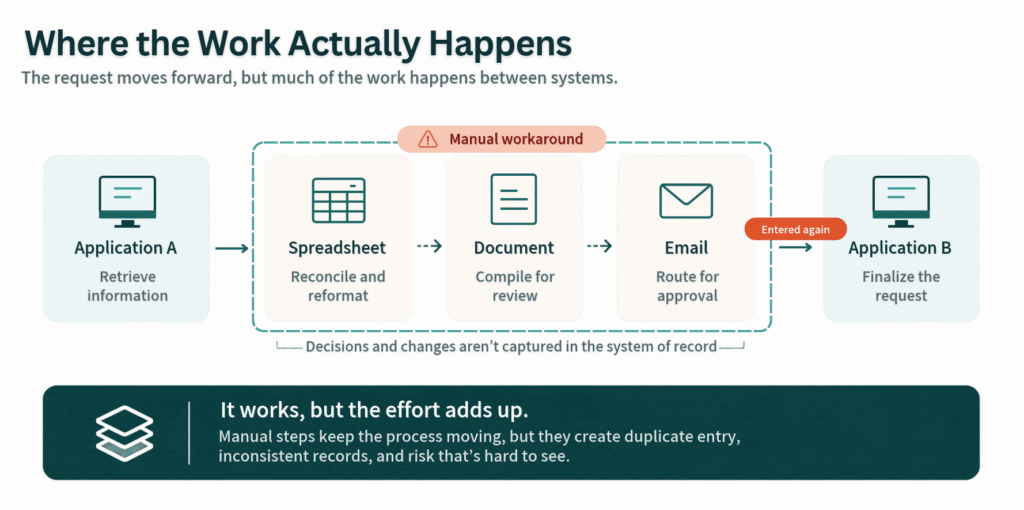
Legacy systems rarely become inefficient overnight. A reporting feature no longer meets the team’s needs, so someone builds a spreadsheet. An approval process changes, and staff begin routing Word documents by email. Two applications cannot exchange information, so an employee copies records from one to the other. Each adjustment makes sense in the moment. Together, they create a second, unofficial system of work outside the application the organization depends on.

That separation has consequences beyond the time it takes to complete a task. Information collected, corrected, or analyzed in those spreadsheets and documents may never make its way back into the system of record. When another team needs it later, they may have to reconstruct what happened, rely on assumptions, or ask someone to enter the same information again. Duplicate entry creates another opportunity for values to differ, records to become outdated, and decisions to be based on an incomplete picture.

Consider an approval that requires staff to pull information from several applications, check it manually, and send documentation across departments. The request eventually moves forward, but the organization may have no consistent record of the decisions and changes made along the way. At scale, this is not merely administrative inconvenience. It makes reporting less dependable and the process harder to audit, improve, or hand off.

A well-designed process keeps relevant information within governed systems, captures decisions as work happens, and makes the current state of a request visible to the people who need it. That does not eliminate every manual judgment. It reduces unnecessary re-entry and ambiguity so employees can focus on the work that actually requires their expertise. Organizations often measure what they spend maintaining software without measuring what it costs to work around it.

The Status Quo Has a Price Tag, Too

Modernization projects require budgets, timelines, and careful risk management. Government leaders should expect to justify those investments. But maintaining the status quo is also a choice, and the cost of delay deserves the same scrutiny.

For the U.S. Forest Service Chief Technology Office, technology delivery had become slow and fragmented. Cynerge worked alongside the agency to improve intake, assessment, and governance processes, helping reduce assessment time from 200 days to 30 days, an 85% reduction. The improvement was not simply a matter of installing newer technology. It came from examining where decisions stalled, how responsibilities were assigned, and what the process needed to support.

That example illustrates why modernization discussions should account for organizational processes as well as applications. The useful question is not only what a replacement system will cost, but how much time, capacity, and opportunity the current way of working consumes.

When Disconnected Information Becomes Operational Risk

When data is scattered across applications and informal workarounds, teams can end up acting on different versions of the same information. A change entered in one place may not appear in another. Reports may omit decisions made offline, while employees spend time trying to determine which record is authoritative. These gaps become especially consequential when the information supports public services, compliance obligations, or safety-critical operations.

The problem is not always the age of the software. Organizational boundaries can shape technology in ways that reinforce disconnected work. When teams design applications independently, they may build overlapping functions or separate data stores without realizing how their processes intersect. Replacing one application will not solve that problem unless the organization also understands the handoffs, ownership, and information flows that connect the work.

Institutional knowledge adds another layer of risk. If only one employee knows how to reconcile a report or recover a critical workflow, the organization has a fragile dependency, even when the underlying system is technically available. These issues can remain invisible until a key person leaves, a requirement changes, or the volume of work increases.

Before Replacing the Software, Understand the Problem

Replacing an aging application may seem like the most direct response to slow processes and unreliable information. Yet a new platform can reproduce the same weaknesses if the team has not understood why the workarounds appeared in the first place. Modernization should begin with discovery: observing day-to-day work, speaking with the people responsible for it, mapping how information moves, and identifying where decisions or responsibilities become unclear.

A reporting problem may originate in fragmented data rather than a weak reporting tool. Delayed approvals may reflect unclear authority rather than slow software. A system that is costly to maintain may need targeted architectural improvements rather than a complete rebuild. These distinctions matter because they lead to different solutions.

At Cynerge, our field-first approach is grounded in four principles: Observe how the work actually happens, including unofficial workarounds; Define the underlying problem before choosing a solution; Build around mission requirements and the people carrying them out; and Prove that the result works in the real environments where it will be used. The goal is not to demonstrate what new technology can do. It is to make the work more reliable and effective.

What Mission-Critical Modernization Looks Like in Practice

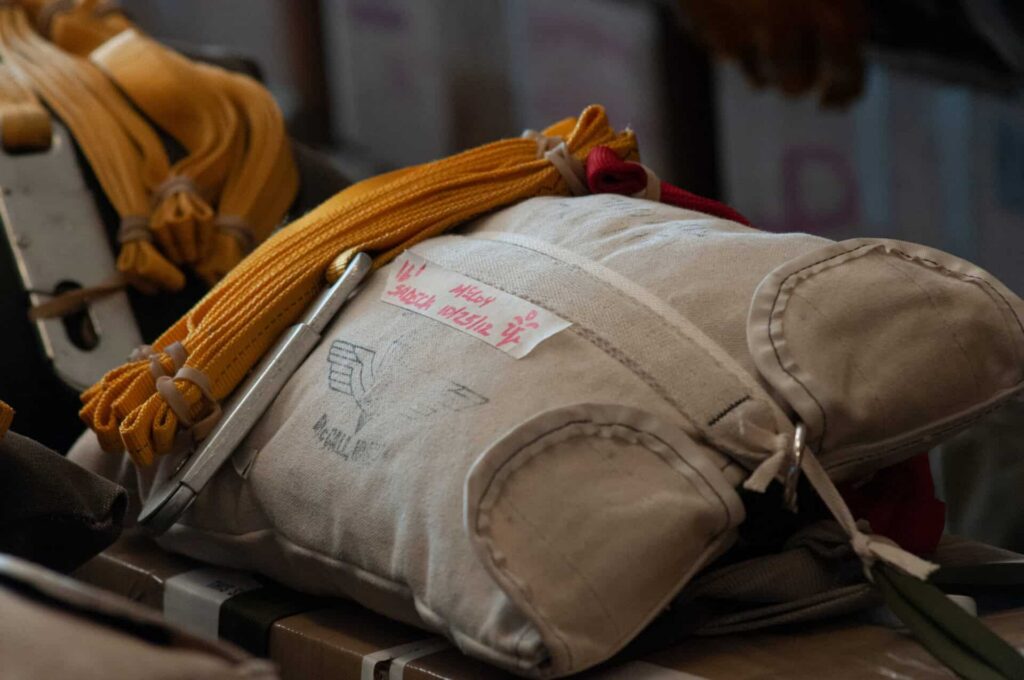
The Malfunction Abnormality Reporting System (MARS), used to document critical safety information in smokejumper operations, shows why reliable data capture matters. Legacy .NET applications, decentralized databases, and manual reporting made it difficult to maintain consistent safety records. For the people depending on that information, the issue was not simply outdated software; it was the challenge of capturing, organizing, and retrieving trustworthy information when it mattered.

Cynerge partnered with the National Interagency Fire Center to modernize the platform, introducing standardized data categorization, real-time dashboards, and a secure SQL backend. More than 1,400 historical records were reclassified while preserving access and data integrity. By improving how information was structured and made available, the project addressed the operational problem behind the technology challenge.

This is the value of modernization in a mission-critical environment: a more consistent process for recording what happened and a more dependable foundation for understanding and acting on it.

Smokejumpers rely on accurate equipment and safety records

Modernization Doesn’t Have to Mean Starting Over

For government agencies, the risks of replacing mission-critical systems are real. Services must continue during implementation, security and compliance requirements remain in force, and historical data cannot simply disappear. Employees also need time to adapt to new workflows.

That is why modernization does not have to be a single, sweeping replacement. The right first move may be integrating systems that should share information, replacing a vulnerable component, clarifying a workflow, or making a broader architectural change. Priorities should follow operational risk, business value, and the organization’s ability to implement improvements without interrupting essential services.

Phased delivery and testing help teams validate progress. Success should be visible in outcomes: less redundant entry, more reliable information, clearer accountability, and fewer avoidable delays. The number of applications replaced is not, by itself, a measure of improvement.

Build for the Mission, Not Just the Technology

The most expensive legacy system is not necessarily the oldest. It may be the one that quietly consumes staff capacity, obscures important information, and forces employees to compensate for gaps in the process every day.

For more than two decades, Cynerge has worked alongside government agencies and mission-driven teams on application development, enterprise architecture, cloud modernization, and governance. Our work starts by understanding the people and processes behind the technology, then identifying improvements that support the mission without disrupting it.

Modernization is not about replacing software simply because something newer exists. It is about making information more dependable, reducing unnecessary work, and building operations that can adapt to what comes next.

Explore how Cynerge approaches mission-critical modernization.

About the Author

Picture of Hanna Shemke

Hanna Shemke

Hanna Shemke keeps Cynerge’s voice sharp and its proposals sharper. As Marketing Director and Proposal Coordinator, she connects vision to execution—making sure every story, strategy, and submission hits its mark.

Related Posts

Leave A Comment

You have big goals with broken systems. We help you with both.

Contact Info