Written by Hanna Shemke, Marketing Director & Proposal Coordinator
Wildfires don’t wait. When flames spread across forests, aircraft must be tracked in real time. Crews in the field depend on accurate data. Leaders need reliable systems to make decisions fast. Every second matters.
But not long ago, many of the U.S. Forest Service’s (USFS) most critical applications were running on aging infrastructure scattered across the country. Systems were siloed. Data centers were overloaded. Deployments were slow and risky.
Jesse Sorge, our Operations & Infrastructure Director, says “It was like trying to fight a wildfire with 182 different hoses — all tangled up, all different sizes. Nothing worked together.”
The Forest Service needed a bold new path. And Cynerge was there to help blaze the trail.
The Problem: Sprawl, Cost, and Risk
At the beginning of this journey, the Forest Service had over 750 applications running in 182 separate data centers and data rooms nationwide.
Managing this sprawl was a nightmare. Costs ballooned as teams struggled to maintain redundant infrastructure. Outages were occurring. Security risks multiplied — one weak link could put dozens of applications at risk.
Early initiatives like the Data Center Consolidation Initiative (DCI) and Data Center Transformation (DCT) cut down the number of applications to about 300 and migrated them into a Virtual Data Center (VDC). It was progress — but the model was still centralized, expensive, and limited.
It was a critical step forward — closer to a cloud-like model — but it still wasn’t enough. Costs remained high, security risks persisted, and the Forest Service knew the future wasn’t just in virtualized data centers, but in commercial cloud.
The Long Road to the Cloud
The move to AWS didn’t happen overnight. In fact, it was the third major chapter in a longer transformation story.
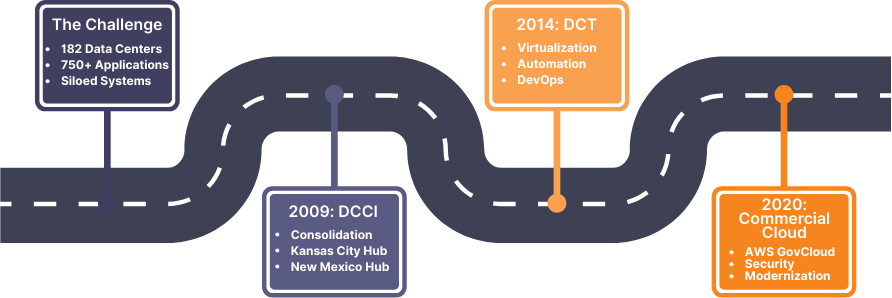
Back in 2009, the Forest Service launched the Data Center Consolidation Initiative (DCCI) — a massive project to move from 180+ server rooms and mini data centers down to just two. Our team supported the application migration effort, moving more than 300 systems into a USDA data center in Kansas City for production and a commercial facility in New Mexico for development and testing. The project finished on time and on budget in just two years — a rare feat for an initiative of that scale.
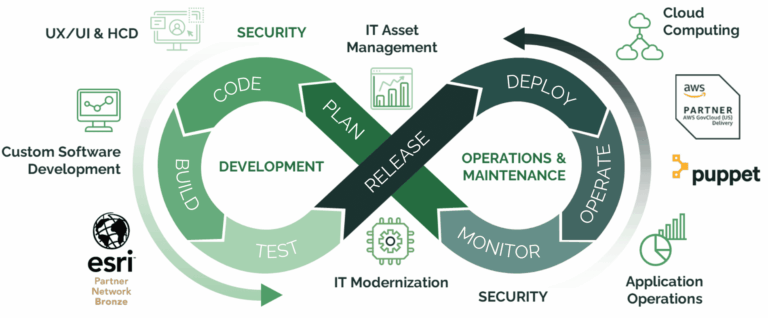
By 2014, the Forest Service entered its second chapter: the Data Center Transformation (DCT). This focused on bringing cloud-like features into USDA’s data centers — virtualization, automation, and early DevOps practices. Over four years, we shifted 300 apps into environments that met NIST’s definition of cloud, while saving money through efficiency gains. We implemented the use of agile and DevSecOps approaches, breaking down silos and creating efficiencies. Tools like Puppet, Jenkins, Docker, Kubernetes, and Terraform became part of the operational toolkit, laying the groundwork for what would come next.
By 2020, commercial cloud was mainstream in government. Federal policy had shifted from “Cloud First” to “Cloud Smart” — emphasizing not just adoption, but the right adoption. For the Forest Service, that meant moving beyond pilots and embracing commercial cloud at scale. After evaluating multiple providers, Cynerge recommended AWS as the first commercial platform for USFS — a choice reinforced by USDA’s own adoption of AWS. Once the decision was made, our team worked diligently to bring it to life.
This three-phase journey — DCCI → DCT → Commercial Cloud — wasn’t just about technology. It was about trust. Over a decade, Cynerge proved it could guide the Forest Service through change after change, building the credibility to take on the AWS mission.
The Strategy: A New Playbook for the Cloud
By 2020, the Forest Service CIO’s Operations and Service Delivery (OSD) office — now named Foundational Digital Services (FDS) — turned to Cynerge to deliver a full re-write of the agency’s Cloud Strategy. We had authored earlier versions in 2013 and 2017, but the 2020 update marked a turning point: a comprehensive blueprint for moving beyond data centers and into commercial cloud at scale.
Our recommendation was bold: move to AWS GovCloud, designed for federal agencies with the strictest security and compliance requirements.
Cynerge is an AWS GovCloud Partner
But the strategy wasn’t “lift and shift.” We’d seen other agencies move their messy garages of legacy infrastructure into the cloud as-is. The result? Same problems, just more expensive.
We wanted something different. Something better. “We didn’t want to move the garbage from the data center into the cloud,” said Jesse. “We wanted to build something new, something better, that the Forest Service could rely on for years to come.”
Our approach was to refactor applications into AWS-native services. That meant modernizing systems so they weren’t just cloud-hosted, but cloud-optimized — faster, more reliable, more secure.
It also meant building governance and repeatable processes. We weren’t just solving today’s problem. We were laying the tracks for every migration that would follow.
The Build: Standing Up the First AWS Environment
With the strategy in hand, it was time to build.
Cynerge designed and launched the Forest Service’s first secure AWS GovCloud environment — also known as the landing zone. This environment established the technical guardrails for every application that would follow:
Zero-trust security model: separating applications into their own accounts so that if one system was compromised, it wouldn’t endanger others.
Governance by design: established technical guardrails, decision-making tools, and review processes from day one — embedding governance into the architecture so migrations were secure, repeatable, and agency-wide.Item
CI/CD pipelines: automated testing and deployments that turned weeks of manual effort into minutes.
Compliance-ready from the start: built against NIST 800-53 Rev 5 security controls, with authentication, DNS, and audit processes established before the first app ever went live.
It wasn’t always smooth. Terraform once wiped out an entire development environment with a misstep. But because resilience was designed in, we rebuilt quickly — and put new safeguards in place.
Luther Jolliff, one of Cynerge’s Solutions Architects, stated that, “Those early failures were like controlled burns. They taught us where to set guardrails so the whole forest didn’t go up in flames.”
Each challenge made the system stronger. Each fix became part of the blueprint.
The First Fire Apps: Proving It Could Work
The first application to migrate was Automatic Flight Following (AFF), the system that tracks aircraft during wildfire operations. The stakes couldn’t have been higher — lives and safety depended on it. The migration was a success. AFF proved that critical fire apps could run securely, reliably, and efficiently in the cloud.
From there, momentum built. Over the next few years, Cynerge supported the migration of 20+ fire applications. Each one was modernized to take advantage of AWS-native services, from containerization with ECS Fargate to serverless computing with Lambda, and managed databases with RDS/Aurora.
For developers, the change was transformational. Gone were the days of manual uploads and ticket queues. Deployments that once took weeks now happened in hours.
Luther put it simply: “All a developer has to do is merge into source control, and 15 minutes later, the site reflects it.
For leadership, the payoff was just as clear: predictable costs, stronger security, and confidence that mission-critical systems would be there when it mattered most.
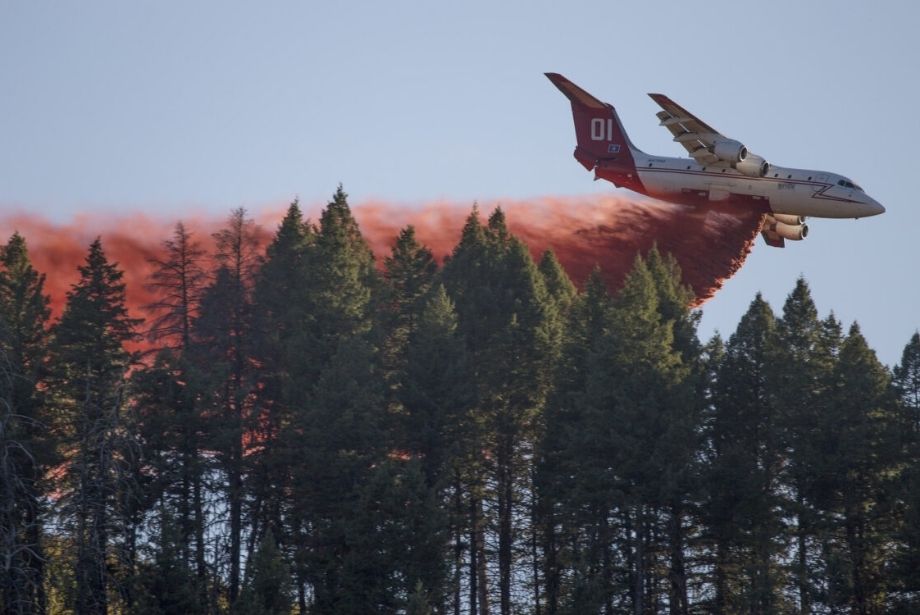
We put out fires in the cloud so the Forest Service can put out fires on the ground.
The Impact: More Than a Migration
Today, the Forest Service’s AWS environment is a model for federal cloud adoption. Cynerge’s work has delivered:
20+ mission-critical apps migrated and modernized — and counting.
Millions saved through right-sizing and cost-optimized architectures.
Security by design, moving from perimeter-based defenses to zero-trust isolation.
Resiliency at scale, with apps spread across multiple availability zones for built-in redundancy.
Faster innovation, giving developers tools to deliver features without waiting on infrastructure.
The impact has rippled beyond USFS. Other agencies, like the Department of the Interior, have since inherited many of these fire applications. While DOI is now responsible for operating them, the foundation and governance Cynerge helped establish with USFS continues to provide a model for how those systems can run securely and reliably in the cloud.
Trusted Advisors, Not Just Contractors
At every stage, Cynerge has been more than an implementer. We’ve been a trusted advisor, shaping strategy, building governance, and ensuring migrations weren’t just done — they were done right.
We wrote the playbook. We built the foundation. We lit the path others are now following. As Luther likes to joke, “We put out fires in the cloud so the Forest Service can put out fires on the ground.”
What’s Next: Stories From the Cloud Frontline
For Cynerge, the story of AWS and the Forest Service is more than just a migration. It’s about showing that government IT doesn’t have to lag behind — it can lead.
Over the next few months, we’ll share more stories from the frontline of cloud migration:
The Pillars of AWS — how security, cost optimization, performance, reliability, operational excellence, and sustainability guided every decision we made.
Deep dives into individual apps — from AFF to the latest tools, and how each one embodies a different aspect of cloud transformation.
Lessons learned — the real challenges we faced, the wins we celebrated, and what other agencies can take away from the journey.
Beaver lake trail, Tongass National Forest, SE Alaska, near Sitka
By combining deep technical expertise with a commitment to operational excellence, Cynerge has helped the Forest Service prove that the cloud can make critical applications faster, safer, and more cost-effective.
And in the middle of wildfire season, when lives depend on the reliability of those applications, that difference matters.
Hanna Shemke keeps Cynerge’s voice sharp and its proposals sharper. As Marketing Director and Proposal Coordinator, she connects vision to execution—making sure every story, strategy, and submission hits its mark.